Healthcare Digital Transformation in Ho Chi Minh City: EMR, Health Data and Smart Healthcare
Quick answer: According to the Ho Chi Minh City Media Center’s year-end review published on 29 December 2025, 163 of the 164 hospitals in Ho Chi Minh City had completed the deployment of electronic medical records (EMR). The 2025 target was for all public hospitals to complete deployment before September 2025. By 2030, the city aims for 95% of residents to have an electronic health record.
Update: This article has been updated to reflect implementation progress and official information published through 2026. The original was published on 23 April 2025 as a news item on the 10 April 2025 healthcare digital transformation conference.
Overview of healthcare digital transformation in Ho Chi Minh City
On 10 April 2025, the Ho Chi Minh City Department of Health held a thematic conference on digital transformation in the healthcare sector to review results and set solutions for the next period. The targets announced at the conference centred on electronic medical records, online public services, digitization of administrative records and electronic health records for residents.
A note on scope: the city’s administrative boundaries were adjusted on 1 July 2025. According to Tuoi Tre newspaper (11 July 2025), the number of hospitals in the city rose from 134 to 164. Figures from April 2025 (51 public hospitals) and from the end of 2025 (164 hospitals) therefore do not cover the same set of facilities. According to Dau Tu newspaper (29 September 2025), the 164 hospitals comprise 14 ministry and sector hospitals, 60 city public hospitals and 90 private hospitals.
Electronic medical records (EMR) in Ho Chi Minh City
2025 target (historical target)
At the April 2025 conference, the Director of the Ho Chi Minh City Department of Health required 100% of public hospitals in the city to complete the deployment of electronic medical records, with a deadline of September 2025. This was a target, not a result achieved at that time.
Progress in April 2025
According to Tuoi Tre (10 April 2025), among the 51 public hospitals at that time, 9 had completed EMR assessment, 7 met the requirements but had not yet submitted documentation, and 35 did not yet meet the minimum requirements.
Latest verified status (end of 2025)
On 29 December 2025, the Ho Chi Minh City Media Center published a review of the health sector’s ten notable events of 2025, reporting that 163 of 164 hospitals had completed electronic medical records. Thanh Nien newspaper (28 December 2025) reported the same figure. These sources do not identify the remaining hospital and do not separate public from private hospitals, so this article does not state that 100% of hospitals, or 100% of public hospitals, have completed deployment.
Direction for 2026
On 20 May 2026, Deputy Director of the Ho Chi Minh City Department of Health Nguyễn Hồng Chương said that all hospitals in the city must deploy electronic medical records and move toward ending the use of paper records (as reported by 1thegioi.vn). At national level, according to Government Portal (Báo Chính phủ) on 10 April 2026, healthcare facilities must complete electronic medical records within 2026; Suc khoe & Doi song newspaper (17 September 2026) gives the deadline as before 31 December 2026 and reports that from 1 January 2027 public hospitals nationwide will no longer use paper records (the sources do not state when this applies to private facilities). The same newspaper (14 September 2026) reported 1,265 healthcare facilities nationwide participating in the national Electronic Medical Record portal. See the related article on the Ministry of Health’s electronic medical record deployment plan (in Vietnamese).
What EMR includes in practice
According to Tuoi Tre’s description of the 2025 plan, the electronic medical record system includes components such as paperless registration, electronic prescriptions, a PACS imaging system replacing X-ray, CT and MRI film, digital signatures in medical workflows, electronic health books and cashless payment.
IT infrastructure and health data interoperability
Hospitals typically run several systems in parallel, such as HIS, EMR, LIS, RIS and PACS. Interoperability means these systems, and hospitals with one another, exchange information using common standards. How these systems connect is explained in HIS, EMR, LIS, RIS, PACS: what they are and how hospital IT works (in Vietnamese).
- May 2024: The Ho Chi Minh City Department of Science and Technology reported that the city was commissioning a shared electronic medical record framework that individual hospitals can customize by size and specific needs.
- Plan presented in April 2025: hospitals complete specialized health databases, connect to the city data center and the national system, standardize data step by step and ensure information security.
- 29 September 2025: according to Dau Tu newspaper, the directors of 164 hospitals signed a consensus to build a centralized data warehouse, organized by the Department of Health, committing to extract, standardize and provide datasets on treatment, workforce, equipment and pharmaceuticals in line with data security regulations.
- May 2026: the Department of Health said referral documents, test results and treatment records will be digitized and linked across healthcare facilities in the city (a plan).
There are no verified published figures on the actual level of interoperability between hospitals today.
Digitization of healthcare administrative procedures
According to Dai bieu Nhan dan newspaper (17 April 2025), targets set for 2025 include 95% of online public services delivered end to end online, 80% of administrative records digitized and 100% of eligible administrative procedures offered online. In remarks republished on 14 April 2025 by the Ho Chi Minh City Children’s Hospital website, the Director of the Department of Health referred to “80% of administrative procedures to be digitized”; the sources word this target slightly differently.
These are targets. No verified official report of results for these targets has been found, so this article does not state results.
Electronic health records and VNeID
- Target (April 2025): 100% of hospitals deploy electronic health books integrated with VNeID; by 2030, 95% of residents have an electronic health record.
- Implementation (2026): according to Tuoi Tre (30 March 2026), the Department of Health, together with the Department of Science and Technology, the City Digital Transformation Center and the Ho Chi Minh City Public Security Department, agreed on a plan to deploy electronic health records for all residents on the Ho Chi Minh City Digital Citizen app. According to a Thanh Nien article republished by the Ho Chi Minh City Media Center on 27 June 2026, from 1 July 2026 each resident has a single electronic health record tied to a personal identification number, displayed on the Digital Citizen app and authenticated through VNeID; the article states a target of nearly 15 million people by the end of 2026.
- 2026 target: on 20 May 2026, the Deputy Director of the Department of Health said the city aims for more than 50% of permanent residents to use electronic health books integrated with VNeID.
No verified published figures are available on how many residents actually have an electronic health record.
2025 targets and the 2030 vision
| Target | Timeline | Type of information | Verified status |
|---|---|---|---|
| 100% of public hospitals complete electronic medical records | September 2025 | 2025 target | 163 of 164 hospitals completed (29 Dec 2025); public and private not separated |
| 95% of online public services delivered end to end online | End of 2025 | 2025 target | No verified result figures |
| 80% of administrative records digitized | End of 2025 | 2025 target | No verified result figures |
| 100% of eligible administrative procedures offered online | 2025 | 2025 target | No verified result figures |
| 100% of hospitals deploy electronic health books integrated with VNeID | 2025 | 2025 target | No verified result figures; electronic health records for residents on the Digital Citizen app, authenticated via VNeID, were announced to launch on 1 July 2026 |
| 95% of residents have an electronic health record | 2030 | 2030 vision | No result figures yet; 2026 targets cited are nearly 15 million people with a record (article of 27 Jun 2026) and more than 50% of permanent residents using electronic health books (remarks of 20 May 2026) |
From EMR to health data and AI
Healthcare digital transformation typically follows this sequence:
- Digital systems inside hospitals (HIS, LIS, RIS, PACS).
- Electronic medical records (EMR).
- Interoperable health data across facilities.
- Data warehouse and data analytics.
- AI-assisted healthcare operations.
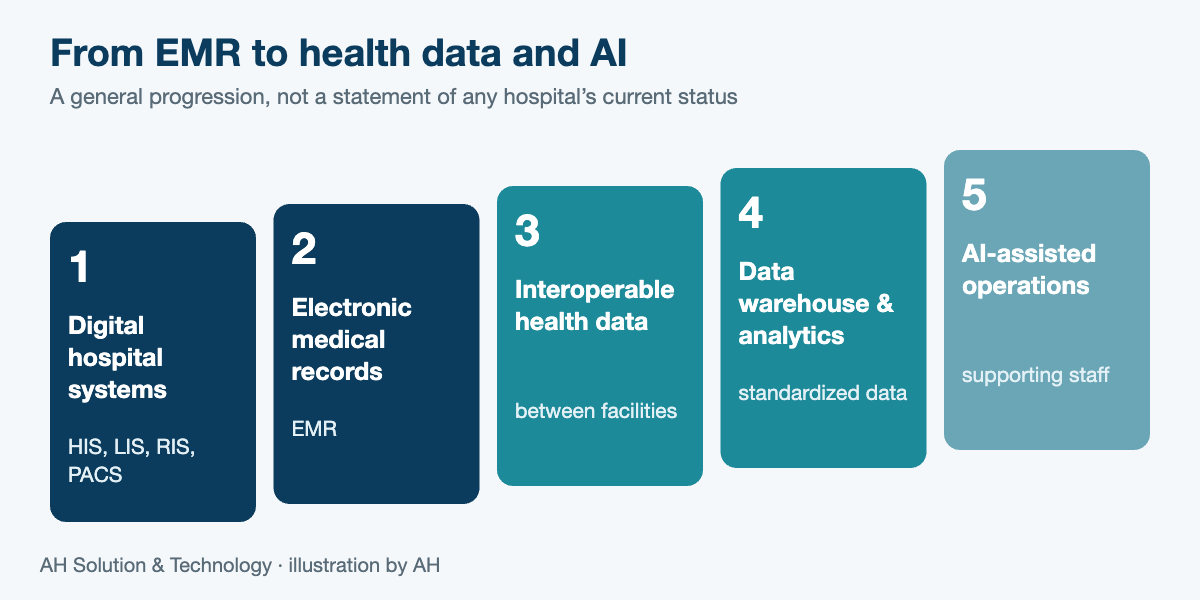
Ho Chi Minh City has taken steps at stages 3 and 4, for example the agreement of 29 September 2025 to build a centralized data warehouse. On AI, the Ho Chi Minh City Media Center’s review of 29 December 2025 states that the health sector is promoting AI in managing and monitoring medical advertising and in receiving public feedback. In May 2026 the Department of Health said it would roll out AI analysis of chest X-rays at primary healthcare facilities across the city, following a pilot on Thạnh An island commune, in a role that supports physicians. These sources describe plans and pilots; there is no basis to state that AI has been deployed at scale in clinical care in the city’s hospitals.
Challenges in implementing digital health
- Interoperability: systems from different vendors need common data exchange standards.
- Data quality: data must be standardized before it can be shared and analyzed.
- Cybersecurity: medical records are sensitive data and require access control and protection.
- Workflow integration: software must fit how doctors and nurses work every day.
- Staff adoption: training and time to adapt are needed.
- Governance: clear rules are needed on managing, sharing and using data.
Conclusion
As of the end of 2025, official sources show that 163 of 164 hospitals in Ho Chi Minh City had completed electronic medical records, against a target for public hospitals to finish before September 2025. In 2026 the city’s focus has shifted to electronic health records, interoperability and a centralized data warehouse, while targets for online public services and digitized administrative records still have no verified published results. The step after EMR is interoperable data and analytics, the foundation for AI-assisted operations.
Editorial note
Compared with the version published on 23 April 2025, this article removes information for which no official source could be found, including a target for the share of cashless payments at healthcare facilities and a figure for the number of facilities in a health data system. The 2025 targets are labelled as targets and are not presented as results.
Sources
Most sources are Vietnamese-language. Each entry notes what it was used to verify.
- Ngành y tế TP.HCM công bố 10 sự kiện nổi bật năm 2025 (Ho Chi Minh City Media Center, 29 Dec 2025): 163/164 hospitals completed EMR; AI in management.
- Từ 1.7, mỗi người dân TP.HCM chính thức có hồ sơ sức khỏe điện tử (Ho Chi Minh City Media Center, republishing Thanh Nien, 27 Jun 2026): electronic health records from 1 July 2026, VNeID authentication, target of nearly 15 million people.
- Các cơ sở khám chữa bệnh phải hoàn thành hồ sơ bệnh án điện tử trong năm 2026 (Government Portal, 10 Apr 2026): completion within 2026 and no paper records from 1 Jan 2027 (scope not specified in the article).
- Lộ trình chuyển đổi sang bệnh án điện tử (Suc khoe & Doi song, 17 Sep 2026): deadline 31 Dec 2026; public hospitals stop using paper records from 1 Jan 2027.
- Toàn quốc có 1.265 cơ sở y tế triển khai bệnh án điện tử (Suc khoe & Doi song, Ministry of Health newspaper, 14 Sep 2026): number of facilities on the national EMR portal.
- Năm 2025, ngành y tế TP.HCM đã làm được gì? (Thanh Nien, 28 Dec 2025): cross-check of the 163/164 figure.
- TP.HCM gấp rút hoàn thành bệnh án điện tử thay bệnh án giấy trong năm 2025 (Tuoi Tre, 10 Apr 2025): April 2025 progress in 51 public hospitals, September 2025 target, EMR components.
- Hội nghị đẩy mạnh hoạt động chuyển đổi số của ngành Y tế TP. Hồ Chí Minh (Ho Chi Minh City Children’s Hospital website, 14 Apr 2025): the Department of Health Director’s remarks on digitizing administrative procedures.
- Chuyển đổi số ngành y tế TP.HCM (Dai bieu Nhan dan, 17 Apr 2025): 95% online public services, 80% digitized records, 100% of eligible procedures.
- TP.HCM: Triển khai hồ sơ bệnh án điện tử tại các bệnh viện công trước ngày 30/9 (Tuoi Tre, 11 Jul 2025): boundary change on 1 Jul 2025, hospitals rising from 134 to 164.
- TP.HCM: 164 bệnh viện ký đồng thuận xây dựng dữ liệu lớn cho ngành y tế (Dau Tu, 29 Sep 2025): composition of the 164 hospitals and the central data warehouse agreement.
- TP.HCM triển khai Hồ sơ sức khỏe điện tử trên Ứng dụng Công dân số (Tuoi Tre, 30 Mar 2026): plan to deploy electronic health records on the Digital Citizen app.
- Y tế TP.HCM: AI thay bác sĩ đọc phim, bệnh án giấy biến mất trong năm 2026 (1thegioi.vn, 20 May 2026): Deputy Director’s remarks on 2026 targets, chest X-ray AI and interoperability; secondary source.
- TP.HCM “đặt hàng” nền tảng bệnh án điện tử dùng chung (Ho Chi Minh City Department of Science and Technology, 30 May 2024): shared EMR framework.
The sources include government agency pages, city media and press. The Ho Chi Minh City Department of Health’s own site was not directly cross-checked (it presented a CAPTCHA, which was not bypassed); for legal or reporting purposes, please consult official documents.
This article is general information about healthcare technology. It is not medical, legal or regulatory advice. Check the source list in the article and the current rules that apply to your organization.